







Published: August 18, 2026
Updated: August 18, 2026

Quick Summary
Proposify analyzed 742,137 proposals worth $3.06 billion in 2026. The data shows that pre-signed proposals close 65% faster, proposals with watched videos are 3.3x more likely to close, and winning proposals average just 11 pages. Proposify streamlines the proposal process with e-signatures, engagement tracking, and pricing customization.
What Happens Between “Proposal Sent” and “Deal Closed”?
Did the buyer read it? Did they skip straight to pricing? Did they share it with another stakeholder? Did the deal stall because the proposal was too long, unclear, or hard to approve?
For many sales teams, the period between sending a proposal and getting a final decision remains a blind spot. They may know the outcome, but they don’t always know how buyers engaged with the proposal, who reviewed it, what sections got attention, or what separated winning proposals from losing ones.
To find out, Proposify analyzed 742, 137 proposals across 30 industries, representing $3.06 billion in total sales proposal value. The data reveals patterns in how buyers review, share, price, approve, and ultimately sign proposals.
Read the full State of Proposals 2026 report
10 Sales Closing Statistics for 2026
Below, we break down 10 sales-closing statistics that show what winning proposals have in common, and how sales teams can use those insights to improve close rates, shorten sales cycles, and build a better buying experience.
1. Average Sales Close Rate Varies Significantly by Industry
Don't judge your close rate in isolation until you know what "good" looks like for your industry. Proposify's 2026 State of Proposals data revealed that the average sales close rate varies widely by industry.
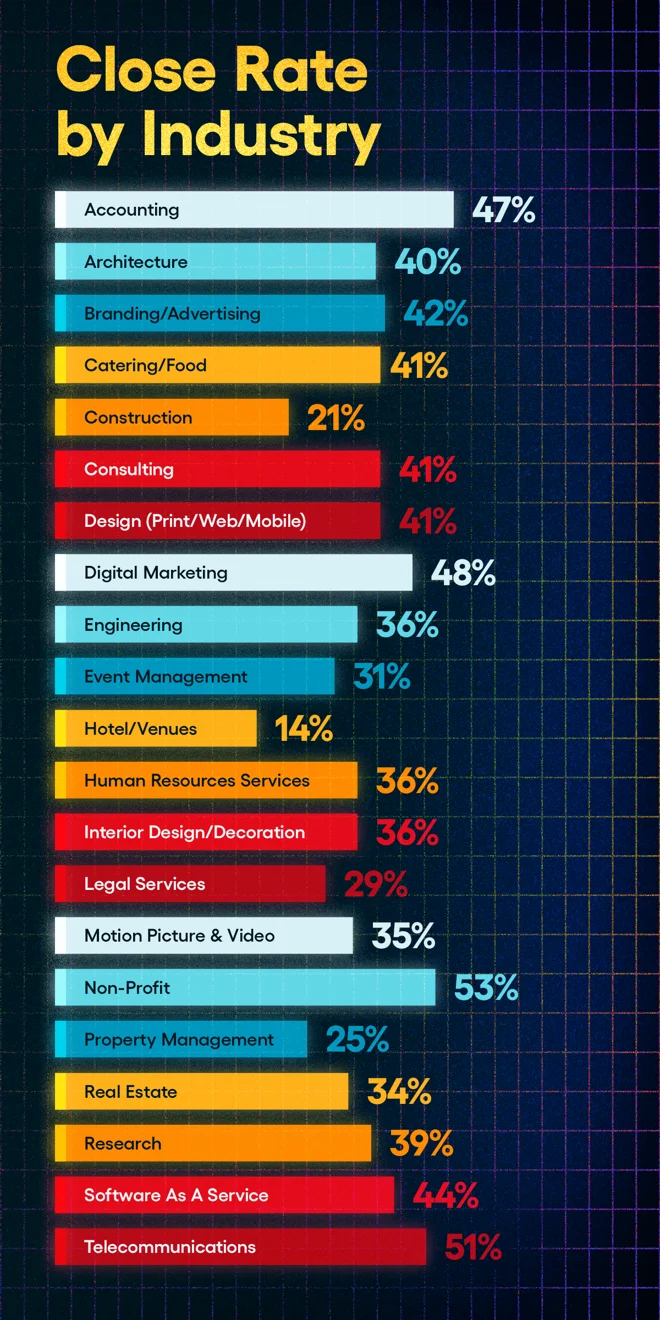
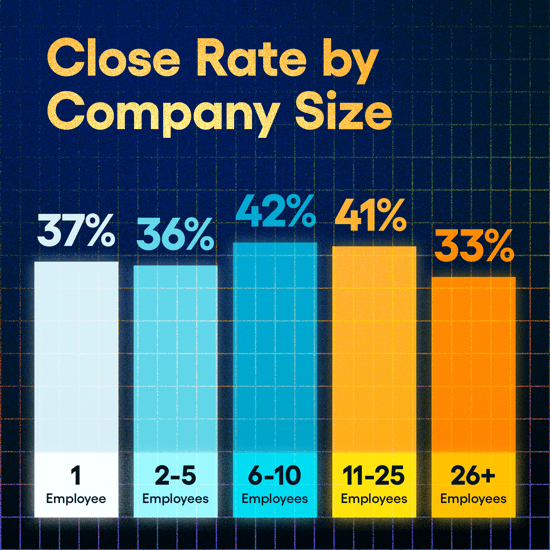
Across all analyzed proposals, the average close rate sits at 34%, but industry benchmarks tell a more specific story. Non-profit proposals closed at 53%, telecommunications at 51%, digital marketing at 48%, and accounting at 47%. On the lower end, construction closed at 21%, while hotel and venue proposals closed at 14%.
This means your close rate only makes sense in context. A team closing 30% of proposals may be underperforming in one industry but doing well in another. Some industries move faster because buyers have clearer needs, repeatable buying processes, or less complex approvals. Others naturally close more slowly because proposals involve larger budgets, greater risk, competitive bidding, or multiple decision-makers.
So before you assume your team has a closing problem, compare your performance to your industry, deal type, and sales cycle. Then look deeper into the proposal behavior behind the number.
Practical Takeaway
- Benchmark your close rate against your specific industry, not a generic sales average.
- Track close rates by proposal type, deal size, and sales rep.
- Compare the close rate with buyer engagement data, such as views, section activity, and stakeholder involvement.
2. Time to Close Also Varies by Industry
If close rate tells you how many proposals turn into deals, time to close tells you how long buyers take to get there. Proposify's data shows that some proposals move quickly, while others take much longer to close.
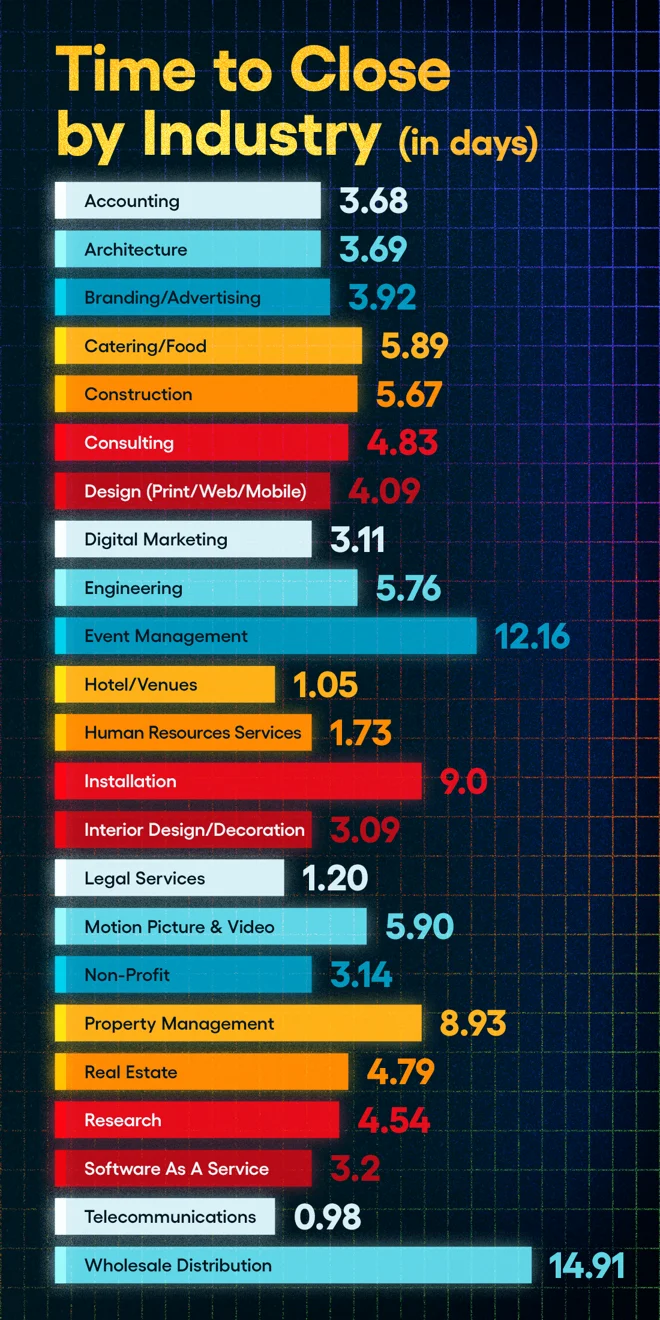
On the faster end, telecommunications proposals closed in 0.98 days, hotel and venue proposals in 1.05 days, legal services in 1.20 days, and human resources services in 1.73 days. On the slower end, wholesale distribution proposals took 14.91 days to close on average, event management took 12.16 days, installation took 9.0 days, and property management took 8.93 days.
That difference matters because follow-up timing should match how buyers actually make decisions. A proposal that has been open for three days may be overdue in one industry but still early in another.
Instead of using one follow-up rule for every proposal, sales teams should use time-to-close benchmarks to understand what normal movement looks like in their market.
Practical Takeaway
- Track your average time to close by industry, service line, and deal size.
- Follow up faster in industries where proposals usually close within one or two days.
- Give complex deals more room, but don’t let silence go unchecked.
- Use proposal engagement data to time follow-ups around real buyer activity.
3. Winning Sales Proposals Average 11 Pages
One of the biggest proposal questions is: how long should a sales proposal be?
According to Proposify’s 2026 data, the average length of winning sales proposals is 11 pages, while losing proposals average 13 pages.
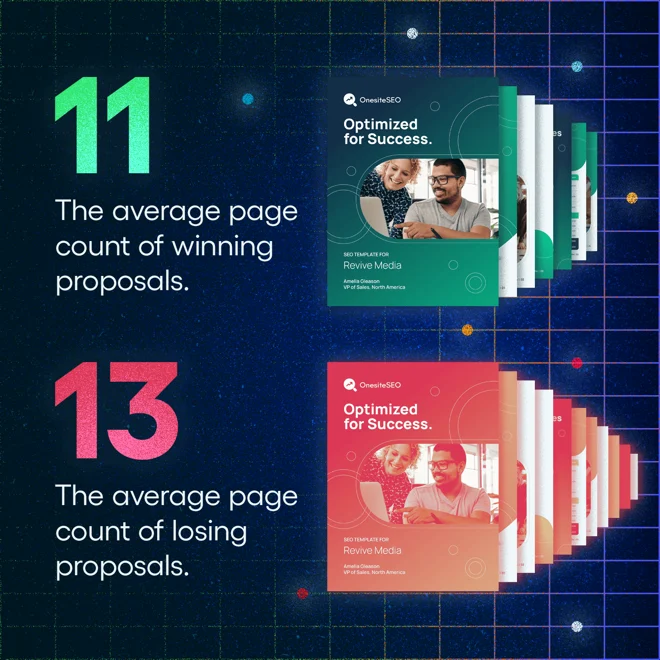
That doesn’t mean every proposal should be forced into 11 pages. Some complex deals require more details, especially when multiple services, stakeholders, pricing options, or legal requirements are involved.
But the pattern is clear: winning proposals tend to be more focused. They give buyers enough information to understand the problem, solution, value, pricing, and next steps without requiring them to wade through unnecessary pages.
Practical Takeaway
- Use 11 pages as a benchmark, not a strict rule.
- Cut generic filler that doesn’t help the buyer decide.
- Keep key sections focused: problem, solution, scope, proof, pricing, and next steps.
- Review losing proposals to see where extra pages may be creating friction.
4. Winning Proposals Average 7 Sections
A winning proposal doesn’t need to include every possible detail. It needs the right sections in the right order. Proposify’s 2026 data revealed that winning proposals include an average of 7 sections.
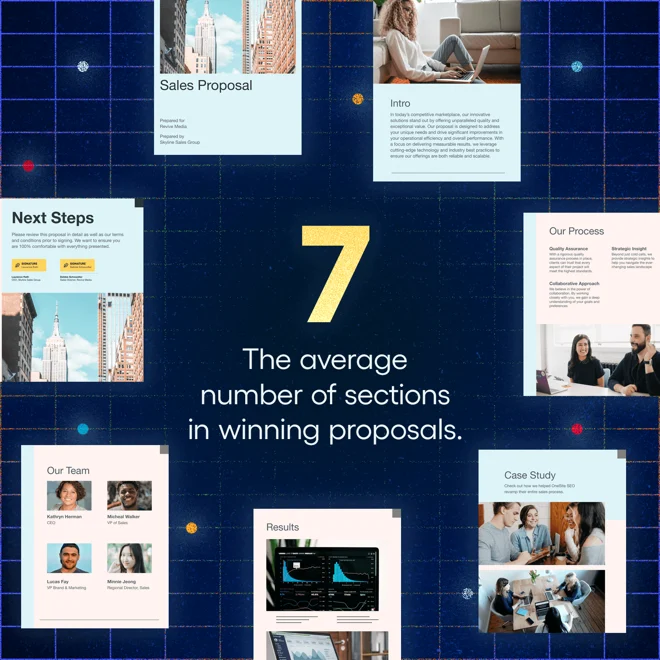
That number gives sales teams a practical structure to work with. A proposal with too few sections may feel thin or incomplete. A proposal with too many sections can overwhelm the buyer, especially if some of those sections don’t help them make a decision. The goal is not to hit exactly seven sections every time. The goal is to guide the buyer from context to confidence to approval.
Practical Takeaway
- Use 7 sections as a structure benchmark, not a rigid rule.
- Keep sections that explain value, scope, pricing, proof, and next steps.
- Remove sections that add length without helping the decision.
- Review your templates to make sure every section has a clear purpose.
5. Buyers Spend Serious Time Reviewing Pricing
The pricing is where buyers start turning your proposal into a decision. It is the section where they start weighing the investment against the scope, deliverables, timeline, and value you’ve already presented.
Proposify’s 2026 data reveals that buyers spend an average of 7.72 minutes reviewing the Pricing/Investment section of a proposal.
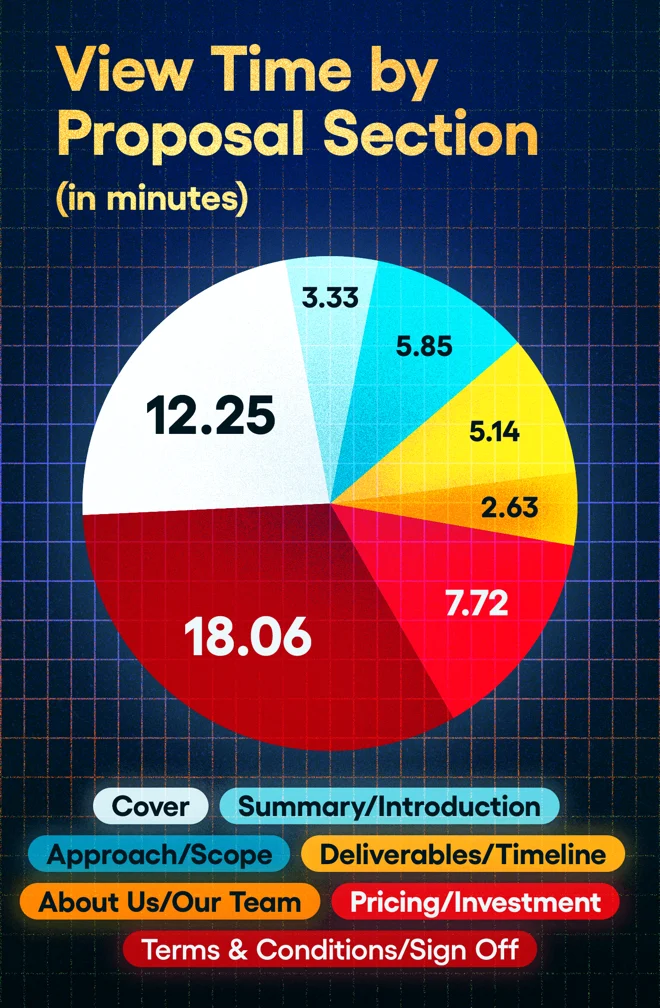
That makes pricing one of the sections sales teams need to get right. If the investment is hard to understand, too vague, or disconnected from the rest of the proposal, buyers may hesitate even if they’re interested in the offer.
Practical Takeaway
- Make pricing easy to scan and understand.
- Break down costs clearly so buyers know what they’re paying for.
- Connect pricing to scope, deliverables, and expected outcomes.
- Avoid making buyers guess what is included in the investment.
6. Interactive Pricing Improves Close Rates
Once buyers reach the pricing section, the way you present options can influence what happens next. Proposify’s 2026 data shows that companies using interactive pricing win 2x more proposals and are 21% more likely to close.
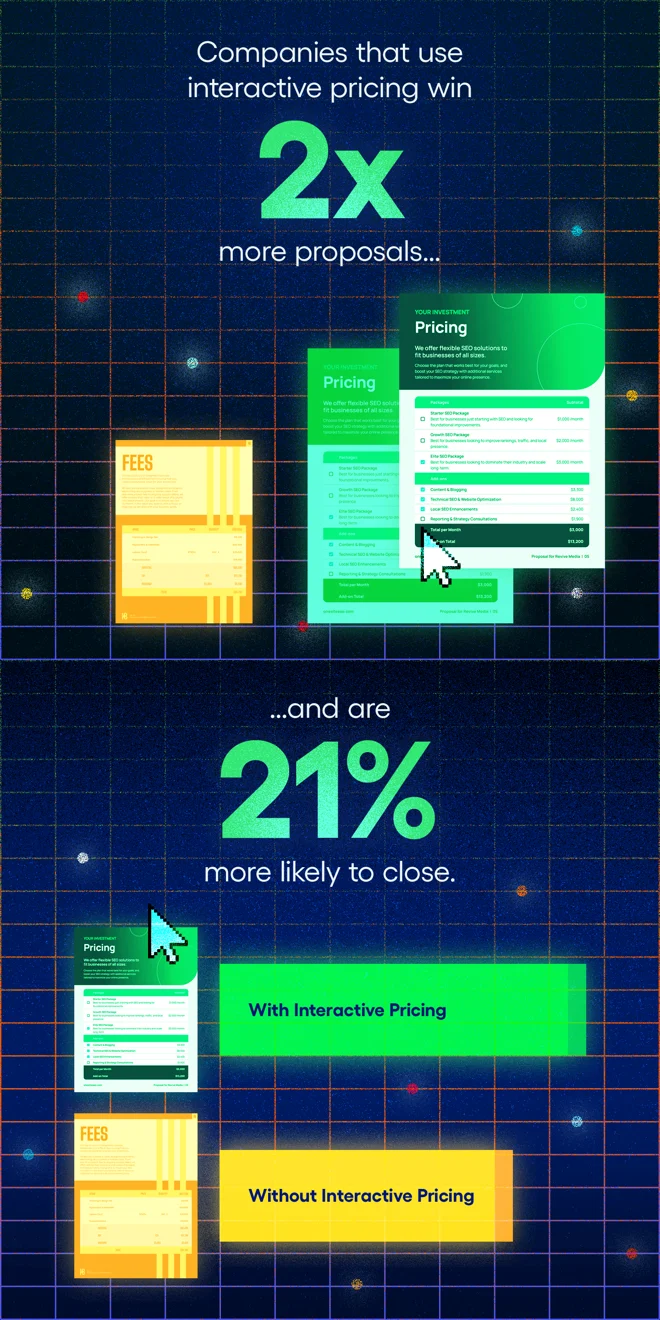
This matters because pricing is where buyers compare value, scope, and fit. A flat pricing table may show the cost, but interactive pricing gives buyers more control over the decision. They can select packages, adjust quantities, choose optional add-ons, or see how different options affect the total investment.
That can make the proposal feel less like a fixed document and more like a buying experience. Proposify helps teams bring that flexibility into the proposal itself, so buyers can review pricing options without extra back-and-forth.
Practical Takeaway
- Use interactive pricing when buyers need to compare packages or options.
- Add optional services or upgrades where they make sense.
- Keep pricing clear so buyers understand how each choice affects the total.
- Use pricing options to guide the buyer, not overwhelm them.
7. Proposals With E-Signatures Have Higher Close Rates
A proposal can do everything right and still lose momentum if signing feels like extra work.
Proposify’s 2026 data shows that proposals with e-signatures have a 15% higher close rate and close 60% faster than proposals without e-signatures.
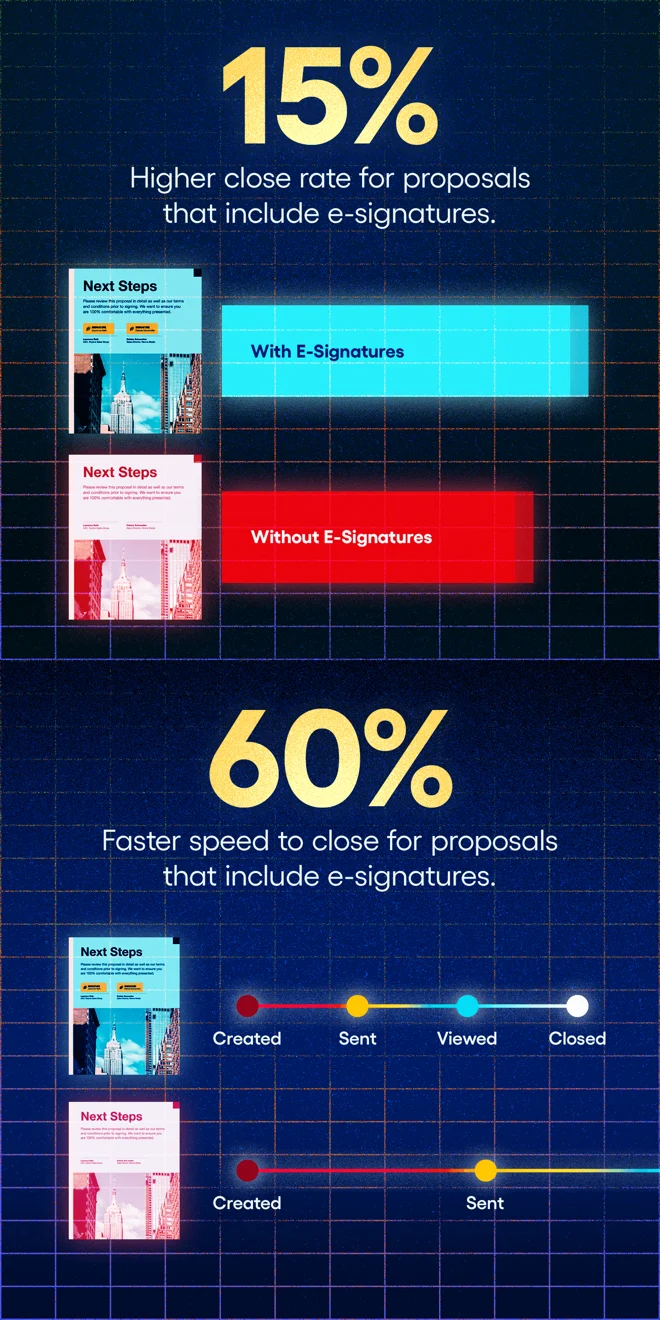
That matters because the approval stage is one of the easiest points at which a deal can stall. If a buyer has to download a PDF, print it, sign it, scan it, and send it back, every extra step creates another chance for momentum to fade. E-signatures remove that friction.
Since Proposify proposals come with built-in e-signatures, buyers can review the scope, pricing, terms, and next steps, then sign in the same online experience when they’re ready to move forward.
Practical Takeaway
- Include a clear approval section in every proposal that needs sign-off.
- Don’t make buyers switch tools or download files just to say yes.
- Use e-signatures to reduce friction at the final decision stage.
- Make sure pricing, terms, and next steps are clear before the signature section.
8. Pre-Signed Proposals Perform Even Better
If e-signatures reduce friction, pre-signing goes one step further: it makes the buyer’s next step feel even clearer. Proposify’s 2026 data shows that proposals signed by the seller before being sent to the buyer see a 65% increase in close rate and close 25% faster.
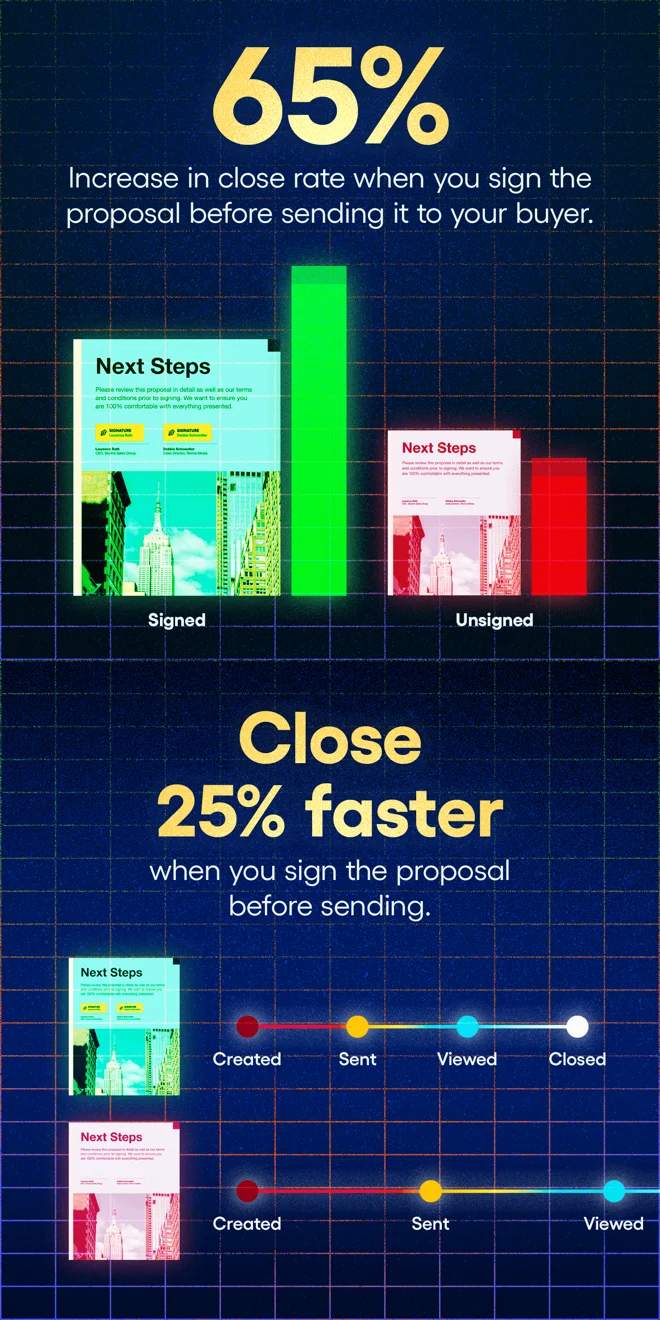
When the seller signs first, the proposal feels more complete and ready for approval. It shows confidence, removes ambiguity, and tells the buyer, “We’re ready to move forward when you are.”
This can be especially helpful when the proposal already includes pricing, terms, and a clear scope of work. Instead of waiting for both sides to complete the agreement, the buyer only needs to review, approve, and sign.
Practical Takeaway
- Pre-sign proposals when the offer, pricing, and terms are final.
- Use pre-signing to clarify the buyer’s next step.
- Ensure internal approvals are completed before the proposal is sent.
- Pair pre-signing with a clear agreement section.
Want more proposal benchmarks?
Read the full State of Proposals 2026 report
9. Proposals With Video Perform Better
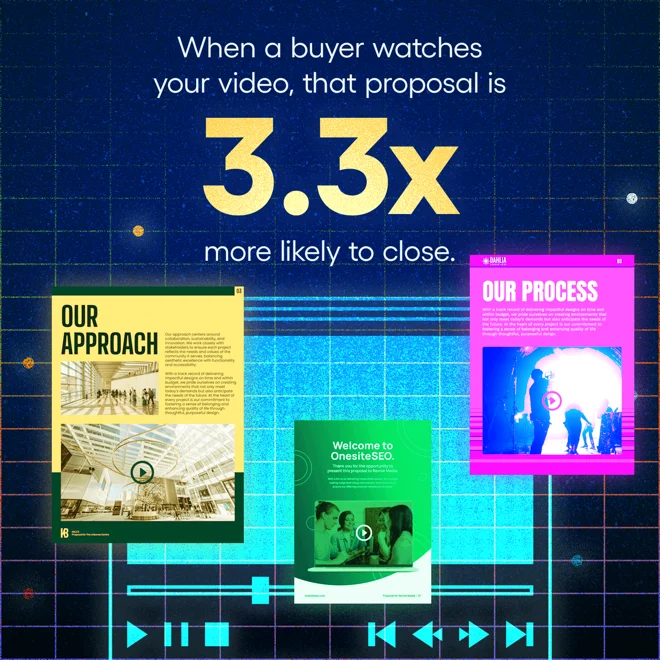
When buyers share proposals internally, context can get quickly lost. Proposify’s 2026 data reveals that when a buyer watches a video inside a proposal, that proposal is 3.3x more likely to close.
That matters because proposals are often reviewed by people who were not part of the original sales conversation. A buyer may forward the proposal to a manager, finance lead, executive, or another stakeholder who didn’t hear your explanation on the call.
Video helps bridge that gap. A short walkthrough can explain the proposal, highlight the most important sections, clarify pricing, or personalize the recommendation for the buyer. With video built into Proposify’s proposal workflow, teams can add that context directly where buyers are reviewing the deal, instead of sending it separately and hoping it gets seen.
The key is to keep it useful. A video should not repeat the entire proposal or feel like extra work. It should help the buyer understand the offer more quickly and provide internal stakeholders with the context they need to support the decision.
Practical Takeaway
- Use video for complex, high-value, or multi-stakeholder proposals.
- Keep proposal videos short, specific, and buyer-focused.
- Use video to explain your recommendation, pricing, or next steps.
- Track whether buyers watch the video, then follow up while engagement is fresh.
10. More Stakeholders Viewing a Proposal Increases Close Rates
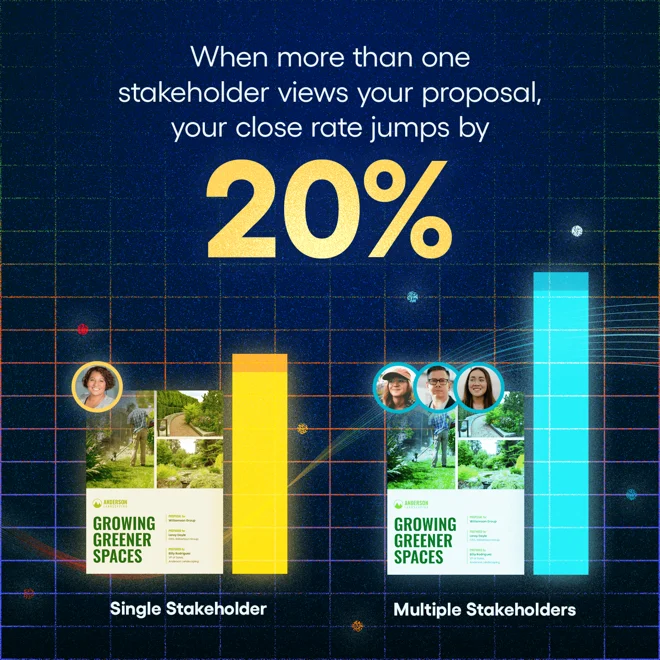
A proposal shared internally is usually still in motion. Proposify’s 2026 data shows that when more than one stakeholder views a proposal, the close rate jumps by 20%.
That matters because most deals are not decided by a single person. Even if you send the proposal to a single contact, they may need input from a manager, finance lead, procurement team, department head, or executive before they can move forward.
When multiple stakeholders review the proposal, it can signal that the deal is being discussed internally. The buyer may be getting buy-in, validating the investment, or sharing the proposal with people who need to approve the next step. Proposify lets sales teams see when internal reviews start to happen, making it easier to spot buying momentum and follow up with the right context.
This is why proposals need to work for more than your main contact. They should be clear enough for someone new to understand the problem, solution, scope, pricing, proof, and next steps without needing the full sales-call context.
Practical Takeaway
- Ask early who else needs to review or approve the proposal.
- Build proposals that are easy for internal stakeholders to understand.
- Make pricing, scope, proof, and next steps clear enough to stand on their own.
- Treat multiple stakeholder views as a signal to follow up with more context or support.
What Winning Proposal Data Reveals About Closing Deals
Winning proposals do more than present an offer. They help buyers understand the value, compare their options, involve the right stakeholders, and move toward approval with less friction.
Across the data, a pattern is clear: high-performing proposals are focused, structured, and easy to act on. They don’t overwhelm buyers with unnecessary pages, but they include enough context to explain the problem, solution, scope, pricing, proof, and next steps.
Winning teams also treat proposals as active sales tools. They use interactive pricing, e-signatures, pre-signed agreements, video, and engagement tracking to make the buying process easier and more visible.
The takeaway:If you want to close more deals in 2026, optimize every step of your proposal process - from when you’re drafting one to when you send it. Proposify is built to help sales teams do exactly that.
Read the full State of Proposals 2026 report or Start a free trial with Proposify.