








Published: March 23, 2026
Updated: March 23, 2026

Quick Summary
This guide breaks down Ignition’s pricing tiers, user limits, add-ons, and annual discounts, showing how costs scale as teams grow. We highlight where smaller accounting teams can lose ROI and explain how Proposify offers more predictable pricing and stronger value for accounting and sales teams that want to scale efficiently.
Is Ignition the Right Choice for Your Team?
Ignition works well for accounting firms that want sales proposals tightly linked to payment collection and client engagements. However, many accounting and advisory teams find that success depends on what happens before payment, especially during the proposal and deal-closing stage.
Ignition’s pricing centers on downstream features like payments, client management, and add-ons that extend beyond the core job of winning new business. For accounting teams focused on closing and scaling client engagements, this structure can mean paying for functionality they use less frequently
This article breaks down Ignition’s pricing and highlights its limitations so you can decide whether it fits your team. We also compare it to Proposify, a proposal management software built specifically to help accounting and advisory teams close deals consistently and at scale
Why Listen to Us?
At Proposify, we’ve spent more than 10 years working with accounting and professional services teams to help them close deals faster and eliminate inefficient workflows.
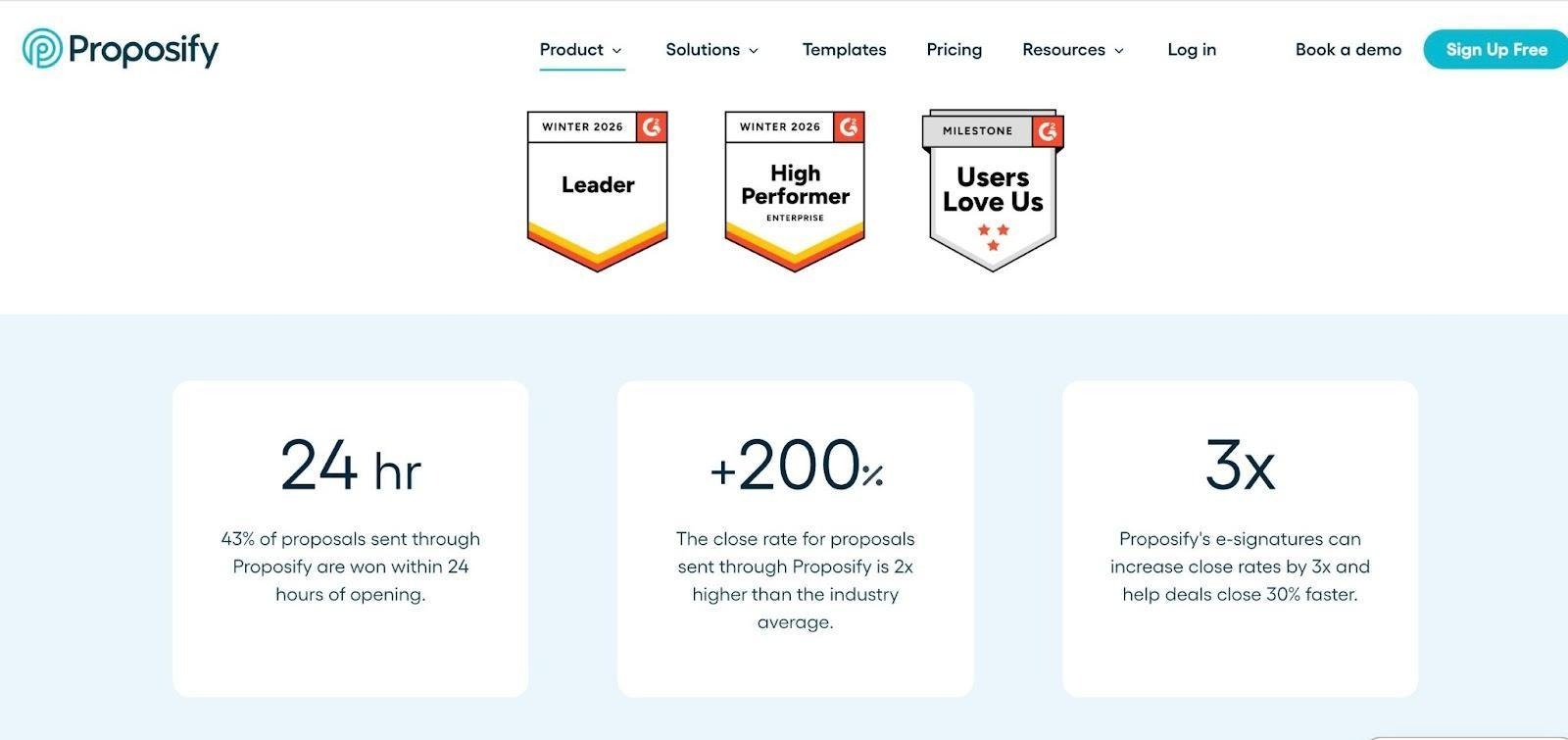 Our proposal management software supports 8,000+ companies, including accounting firms, giving us direct insight into how teams use proposal tools and where pricing models create friction as volume grows.
What Is Ignition?
Ignition is a client management and proposal software for accountants, bookkeepers, and other professional services firms that helps them create, send, and manage proposals, engagement letters, and payment terms in one integrated system.
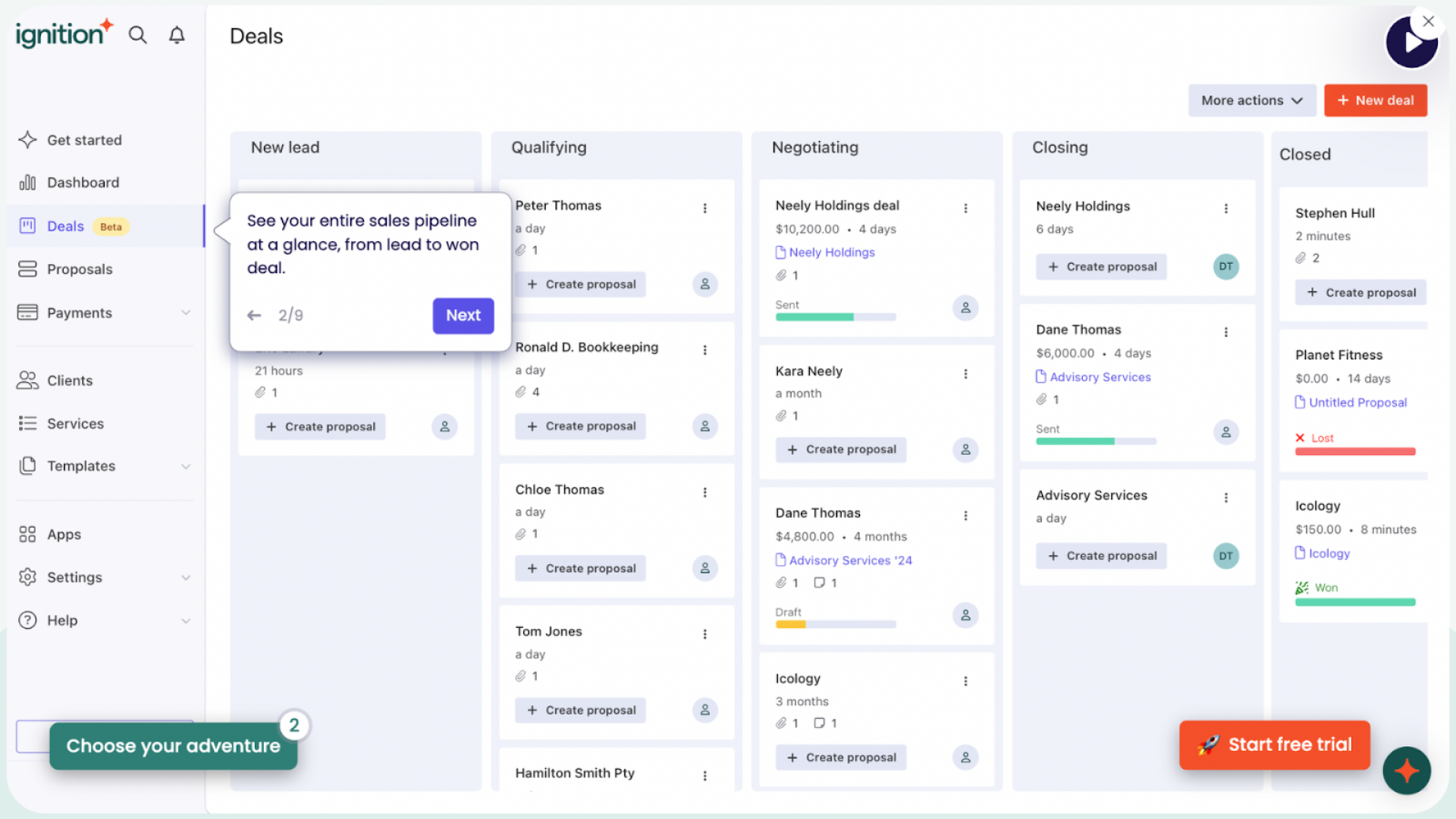
It standardizes and automates how firms price their services, obtain client approval, process payments, and scope work to reduce manual follow-up and improve cash flow.
Ignition’s Pricing Structure
Ignition uses bundled pricing to lock essential proposal features behind higher-tier plans.
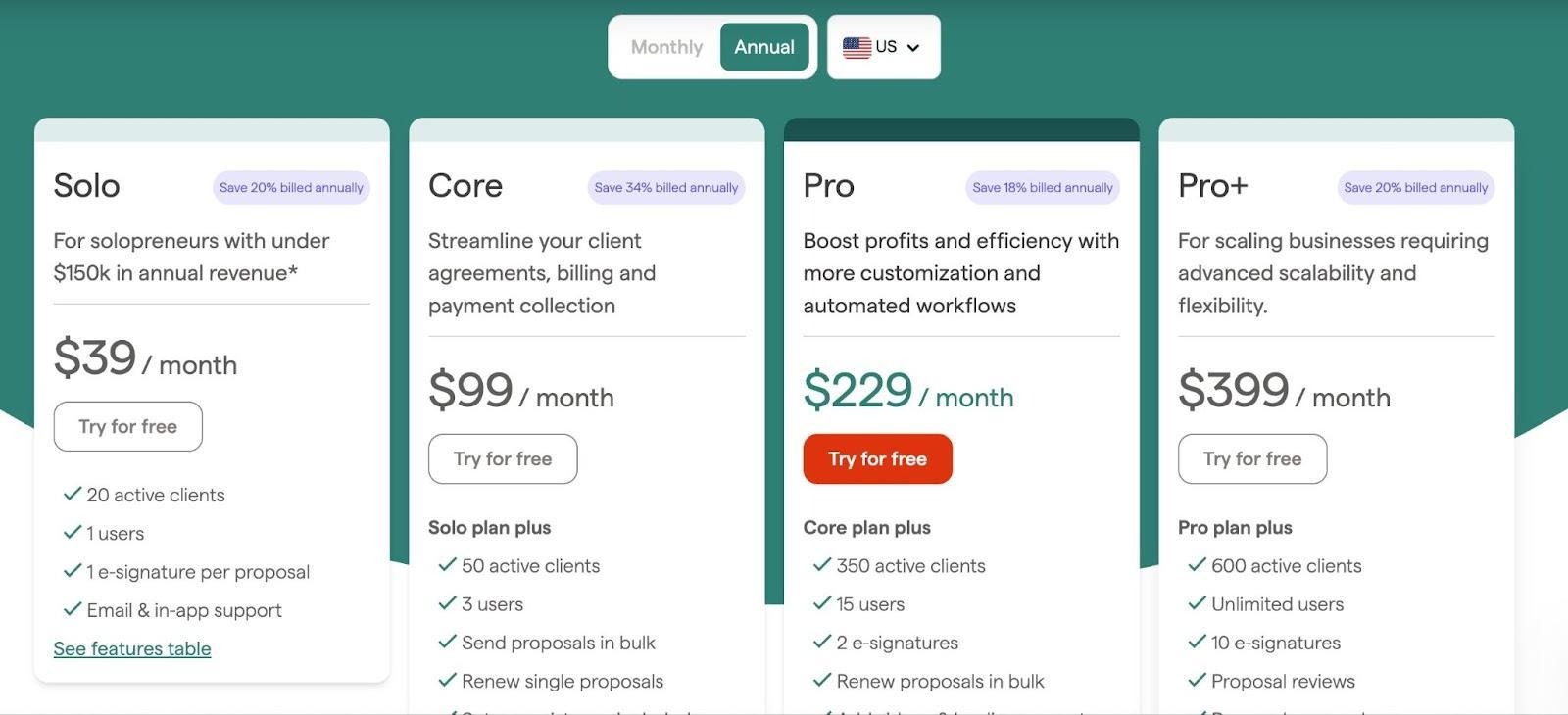
- Solo: $39/month
- Core: $99/month
- Pro: $229/month
- Pro+: $399/month
- Enterprise needs: Custom pricing
Optional Add-ons
- Deals Pipeline: $39/month
- Online Forms: $39/month
Ignition Pricing Table
|
# |
Feature |
Solo $39/month |
Core $99/month |
Pro |
Pro+ |
|
1 |
Active clients with signed agreements |
20 |
50 |
350 |
600 |
|
2 |
Cost per additional active client (over plan inclusion) |
$7 |
$5 |
$3 |
$2 |
|
3 |
Users |
1 |
3 |
15 |
Unlimited |
|
4 |
E-signatures per proposal |
Single |
Single |
Up to 2 |
Up to 10 |
|
5 |
Bulk proposal creation |
No |
Yes |
Yes |
Yes |
|
6 |
Proposal renewals |
No |
Single |
Bulk |
Bulk |
|
7 |
Adjust pricing in bulk |
No |
No |
Yes |
Yes |
|
8 |
Additional document signatures |
No |
No |
500 docs/year |
Unlimited |
|
9 |
Proposal expiration dates |
No |
No |
Yes |
Yes |
|
10 |
Price Insight |
Add-on |
Add-on |
Add-on |
Add-on |
Ignition’s Pricing Plans Explained
1. Solo
The Solo plan is built for independent practitioners and solopreneurs with up to 20 active clients who want to formalize proposals and agreements without complex billing needs. It costs $39/month and includes basic proposal tools, limited , and essential billing features.
However, more advanced capabilities like recurring billing, bulk actions, and deeper integrations are only available on higher plans
2. Core
The Core plan gives multi-person teams consistency and control over proposal management. With this plan, teams can attend to and manage 50 active clients with 3 users for $99/month.
Compared to Solo, it introduces bulk proposals, stronger billing connections, custom brochures, and basic integrations with accounting systems. That said, it still lacks advanced recurring billing automation, flexible payment schedules, and bulk renewals.
3. Pro
The Pro plan provides advanced features for growing firms that rely heavily on recurring services and value-based pricing. It’s designed for firms that want their proposals, billing, and payment collections to operate as a single and connected process rather than separate steps.
This tier costs $229/month and allows firms to serve up to 350 active clients with 15 users. Its features include recurring invoices, billing automation, flexible payment schedules, two e-signatures per proposal, bulk renewals, and custom branding.
However, features like higher signature allowances, proposal review workflows, and pipeline tracking are reserved for Pro+ users.
4. Pro+
Pro+ is Ignition’s most advanced plan and is intended for larger or more complex firms. For $399/month, firms get tighter control over pricing structures, payment workflows, and the flow of proposal data into other systems.
The plan allows up to 600 active clients with unlimited users. Features include 10 e-signatures per proposal, proposal reviews, unlimited document signatures, deal pipeline visibility, and deeper control over pricing and payment workflows.
Despite its broader capabilities, the plan may not be ideal for teams whose priority is centralizing proposal management over billing and revenue workflows.
Ignition Pricing: Pros & Cons
Pros of Ignition Pricing
- Enforces scope and payment terms upfront, improving cash flow
- Tiered plans that allow firms to start small and scale
- Supports fixed-fee and recurring billing.
- Centralizes proposals, contracts, billing, and payments in a single workflow
Cons of Ignition Pricing
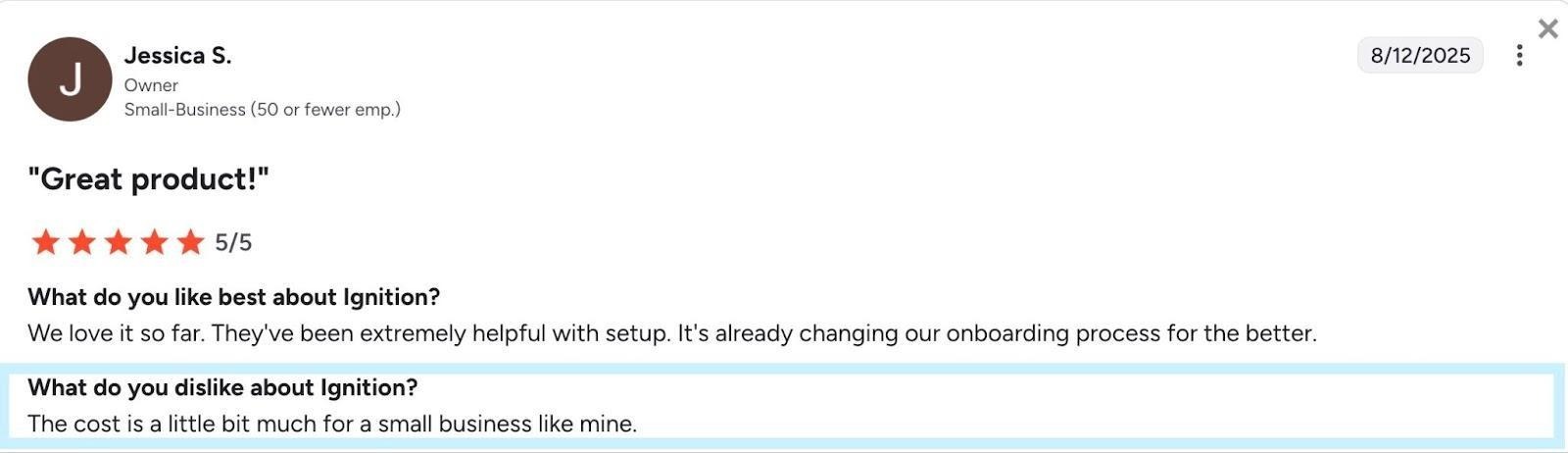
- May be expensive for small firms
- Payment fees increase total spend
- Lower ROI for sales-focused teams
Key Features of Ignition
Below are four key features of Ignition:
1. Structured proposal templates
Ignition’s proposal template editor standardizes how proposals are created. Its customizable checklists and reusable layouts help reps include the right sections, pricing, and approvals every time. This reduces errors and prevents stalled deals due to missing information.
2. Centralized Content and Pricing Library
Ignition organizes and stores approved proposal content and pricing information in one central location. This helps sales reps quickly access accurate content and pricing for their proposals, keep documents consistent, and avoid mistakes.
3. Real-Time Reports
Ignition provides visibility into how prospects engage with proposals after they are sent. Teams can see when a proposal is opened, how long it is viewed, and which sections receive the most attention, and use this information to adjust messaging based on real buyer behavior.
4. Secure E-Signatures
Built-in e-signatures allow prospects to review and sign documents online without needing to print, scan, or email documents. This shortens the time between proposal approval and deal closure.
Hidden Costs and Limitations Teams Face When Working With Ignition
Ignition can be a powerful tool, but here are five limitations teams face when working with the software:
1. Rising Subscription and Merchant Fees
Ignition’s subscription cost, combined with payment processing and merchant fees, adds up quickly over time.
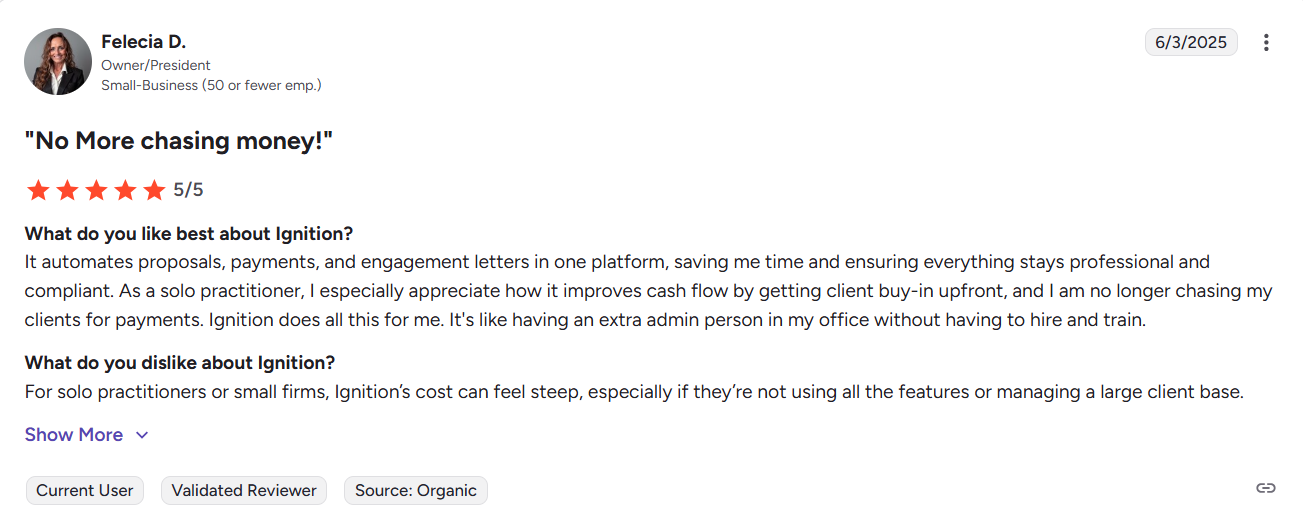
This can make the platform feel expensive for solo practitioners and smaller firms, especially if they are not using its full range of features.
2. Limited Features on Lower Tiers
Certain controls, such as approval workflows, proposal analytics, multiple signature options, and smoother change-order handling, are not available on every tier. With essential features locked behind higher plans, teams may need to upgrade sooner than planned or budgeted.
3. Payment Processing Gaps
Some users have noted that Ignition has long payment processing times, issues handling end-of-month fees, and no option to issue partial refunds inside the platform.
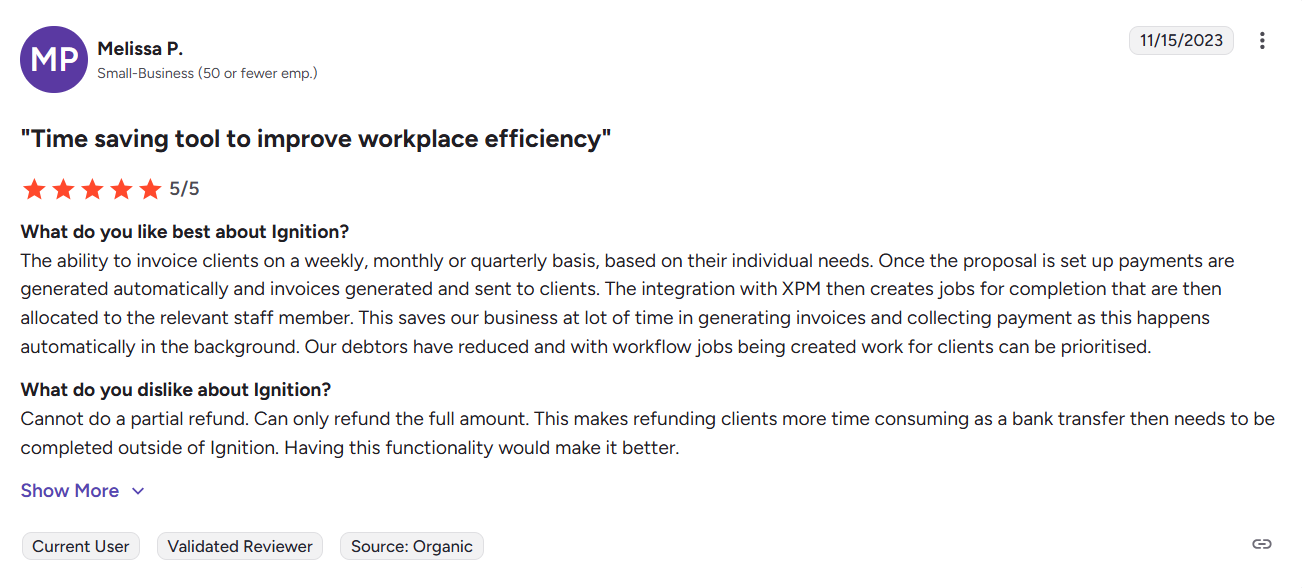
These constraints add extra manual steps to the billing process, slowing teams down.
4. Restricted Proposal Customization Features
Ignition has limited design flexibility, static contract language, and formatting constraints.
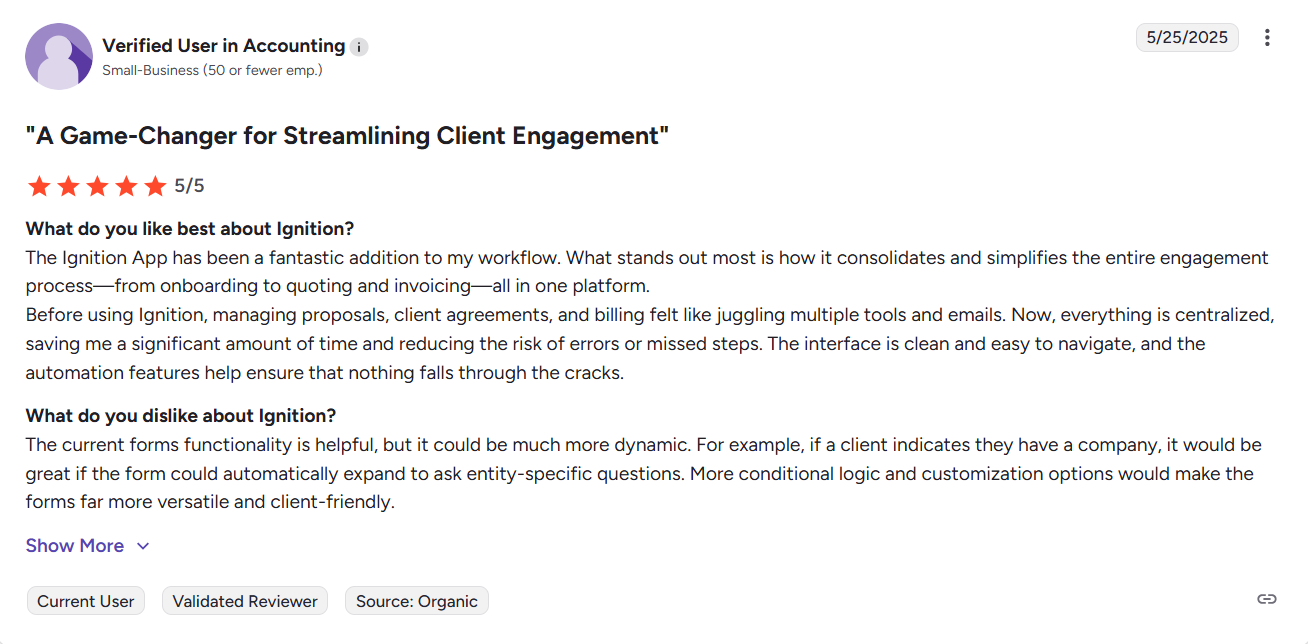
For professional services and consulting firms in particular, this can make it harder to fully tailor proposals to their brand or client needs.
5. Limited Reporting Depth
While Ignition offers integrations with tools like QuickBooks Online, some users have noted that the platform has limited reporting depth and missing CRM connections. This means teams need to check multiple systems to track payments and revenue, reducing overall visibility.
Proposify: The Best Ignition Alternative
When accounting firms rely on a tool built primarily around billing, proposal performance can take a back seat. In-house marketing teams focused on shortening sales cycles, maintaining brand consistency, and collaborating efficiently often run into limitations. Ignition prioritizes payment workflows over proposal optimization.
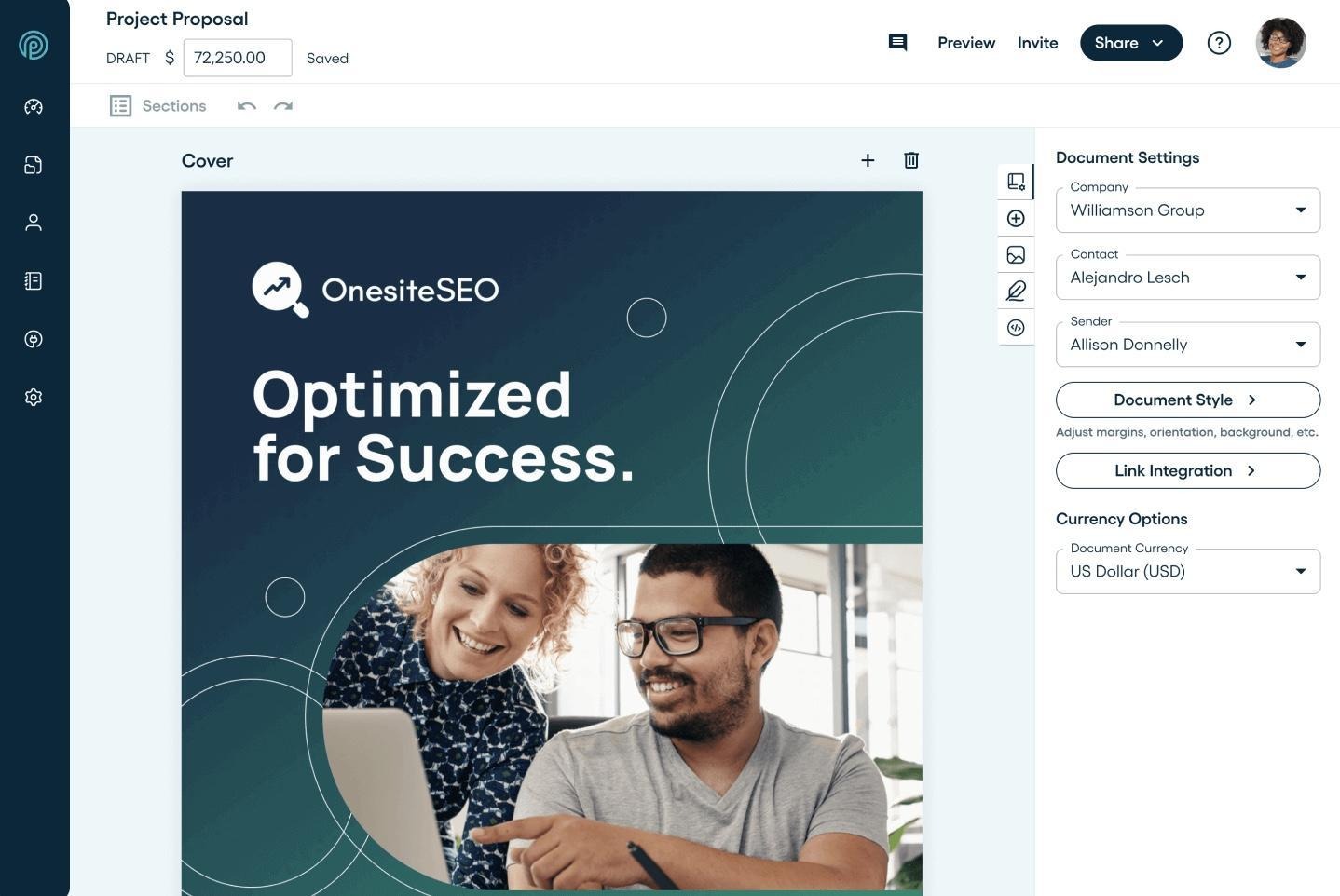
That’s why many accounting and advisory teams turn to Proposify. Built specifically for the closing stage of the client acquisition process, Proposify has helped multiple accounting teams improve proposal performance, not collections.
It offers flexible design control, structured approvals, interactive pricing, and real-time engagement tracking in one focused workflow. Unlike Ignition, Proposify’s pricing follows a proposal-first model, giving teams visibility into buyer behavior and document activity so firms can move opportunities forward with confidence.
Ignition Pro Plan vs Proposify Team Plan: Which Is the Better Buy?
Here’s a side-by-side comparison of Proposify’s Team plan and Ignition’s Pro plan to help you determine which one is right for your team:
|
# |
Feature |
Ignition Pro Plan $229/month |
Proposify Business Plan $65/month |
|
1 |
Proposal customization |
Standard proposal creation with limited design flexibility |
Unlimited templates with a shared content library and embedded media |
|
2 |
Online signatures |
Included |
Included |
|
3 |
Interactive quoting |
Integrated billing and recurring payment configuration |
Interactive pricing tables with optional line items, quantity adjustments, and approval triggers |
|
4 |
Active client capacity |
350 active clients |
Unlimited |
|
5 |
Internal approvals |
Basic workflow control |
Multi-layer approval routing with content locking and role-based permissions |
|
6 |
Engagement tracking |
Limited visibility into proposal engagement behavior |
Real-time tracking with section-level analytics and engagement insights |
|
7 |
CRM Integrations |
Native Salesforce and HubSpot integration |
Native Salesforce, HubSpot, and additional CRM integrations with advanced field mapping |
|
8 |
Best for |
Accounting firms prioritizing proposal-to-payment automation |
Accounting and advisory firms focused on proposal performance, brand control, and CRM-driven visibility |
Why Proposify’s Pricing Fits Sales Teams Better
1. Flexible Plan Tiers
Proposify uses a tiered, per-user pricing model (Basic, Team, Business). This means that teams can pick the level of proposal functionality they actually need and avoid paying for tools that do not match their workflow.
2. Predictable User Pricing
Proposify’s predictable subscription rates make it easier to calculate costs based on the number of staff creating proposals.
3. All-Inclusive Pricing System
With Proposify, teams don’t need to upgrade just to access core proposal functionality. Even on the Basic plan, you get unlimited templates, a shared content library, and the essential tools needed to create, send, and manage proposals day to day.
4. Clear Upgrade Path
Upgrading with Proposify is straightforward. As your business scales and needs expand, you can move to the next plan without having to rebuild your proposal workflow or switch tools.
5. Sales workflow focus
Proposify’s plans are designed around proposal management and closing visibility, not bundled billing features. This keeps value tied to how sales teams work in practice.
Close More Deals with a Proposal Tool Built for the Sales Process
Ignition is a great choice for firms that depend on tightly integrated billing and recurring payment workflows. But if your priority is improving proposal performance and closing deals faster, that bundled structure may feel restrictive, especially at lower tiers.
In these cases, Proposify offers a better workflow fit. It centers on proposal design, collaboration, and buyer engagement, with tiered per-user pricing that scales cleanly. Sign up for free or book a demo today to see how Proposify streamlines your proposal process and supports faster closes.